Thomas Cole
1801 ... 1848 · New York and the Connecticut River Valley
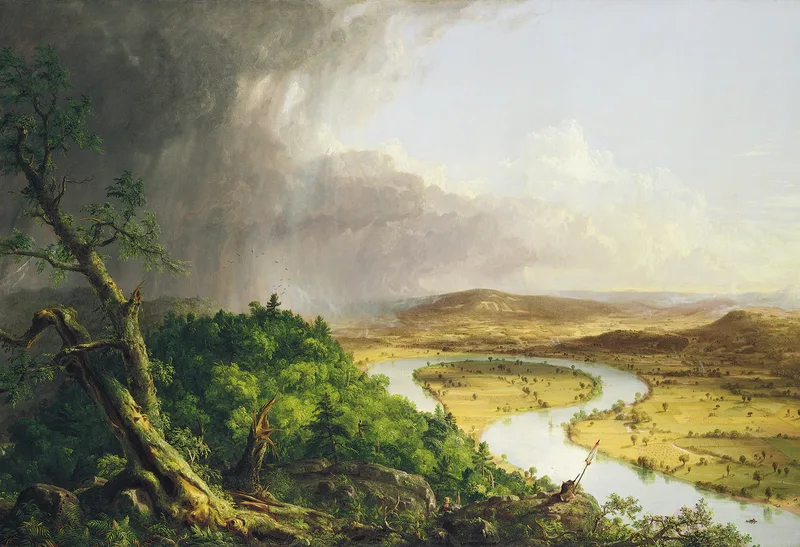
Cole split one view between wild storm and ordered farmland, then put himself at the hinge between them. See the documented work.
Biography
Thomas Cole arrived in the United States from England as a teenager. He worked as an engraver and portrait painter before landscapes became his main subject.
His paintings helped establish the Hudson River School. The name came later, but the idea was already visible: American land could carry drama, history and argument on the scale of European painting.
Cole did not simply copy a view. He sketched outside, built the final picture in the studio and used weather, light and distance to ask what settlement was doing to the land.
How Thomas Cole Worked
The Oxbow began with a real bend in the Connecticut River and a sketch made on site. Cole then divided the canvas between a storm-darkened slope and a sunlit grid of farms. He even placed himself near the center, looking back at us from his easel.
What Backs This Record
The Metropolitan Museum of Art holds the painting, identifies Cole as its maker, and records the date, medium, dimensions, ownership, and object number.
Cole died in 1848, so the work itself is out of copyright. The Metropolitan Museum of Art marks its image of The Oxbow as public domain.