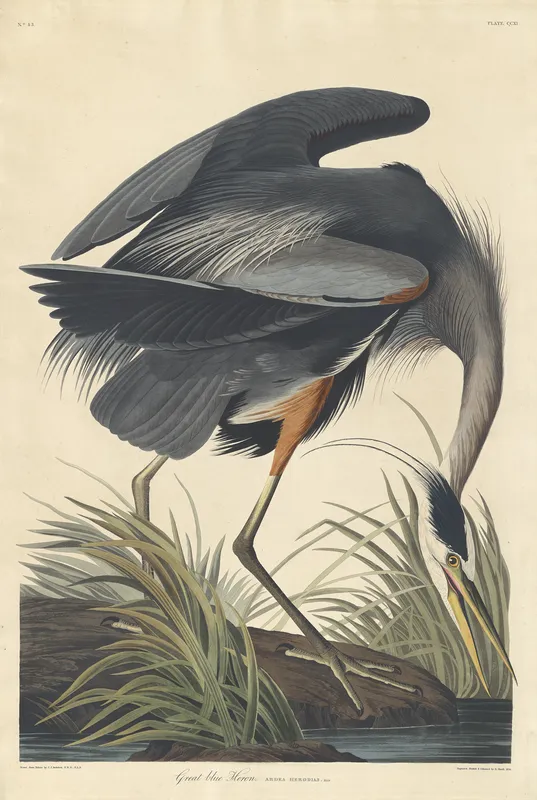
Great Blue Heron (Ardea herodias), Study for Havell Plate 211
- Medium
- Watercolor, oil, pastel, graphite, gouache, black ink and collage on paper, laid on card
- Dimensions
- 91.9 x 64.5 cm (36 3/16 x 25 3/8 inches)
- Year
- 1821, reworked 1834
- Availability
- In a museum collection, not for sale
- Collection
- New-York Historical Society
- Accession Number
- 1863.17.211
- Credit Line
- Purchased for the Society by public subscription from Mrs. John J. Audubon
- Copyright
- Public domain
Description
A great blue heron drawn at life size, which is the reason the sheet is nearly a yard tall. This is the working watercolor Audubon sent to London, and the engraver Robert Havell Jr. turned it into plate 211 of The Birds of America.
Look Closer
The clean printed line belongs to Havell's finished plate. Audubon's original study beneath that image was built from watercolor, oil, pastel, graphite, gouache, ink and collage.
How It Was Made, and What Changed
Audubon painted the bird in Louisiana in 1821. Thirteen years later, in London, he went back into the foreground with oil paint right before the plate was engraved. The sheet holds seven different materials plus a piece of collage, all stacked on paper that was then laid onto card. A finished print hides that kind of history. The working sheet shows it.